New Dietary Guidelines: What is Going On!?

New dietary guidelines were released on January 7, 2026, introducing an upside-down food pyramid and sparking a lot of chatter on social media. But before we get into nutrients, controversy, and hot takes, let’s start with the basics.
First, What Are the Dietary Guidelines for Americans?
Every five years, the U.S. government releases an updated set of recommendations on healthy eating called the Dietary Guidelines for Americans. They’ve served as the cornerstone of U.S. nutrition policy for nearly half a century.
And while they often get discussed like clinical guidelines, that’s not actually their role. The DGAs are population-level guidance, designed to inform:
- Federal nutrition programs
- Food policy
- Public health priorities
They are not individualized meal plans and they were never meant to be.
A Quick History Lesson
The USDA first promoted the Food Pyramid in 1992, adapting a concept that originated in Sweden in the 1970s.

Then in 2005: The Food Guide Pyramid was introduced

In 2011, that visual shifted to MyPlate: a simplified depiction of food groups and portion balance.

Each iteration reflects not just nutrition science, but also how policymakers attempt to communicate that science at scale.
And in 2026, we’re back to the pyramid, but upside-down

I guess South Park called it over a decade ago!! If you need a laugh, check this out:

Why These Guidelines Matter
Beyond education, the DGAs serve as the foundation for federally funded nutrition programs, including:
- Supplemental Nutrition Assistance Program (SNAP)
- School foodservice programs
- Elder-care and child-care nutrition standards
Taken together, these programs make the federal government the largest food purchaser in the country. That means the DGAs don’t just influence what Americans are told to eat, they shape:
- What foods are produced
- How foods are formulated
- How foods are marketed nationwide
People will argue, “who cares about the changes because no one follows the guidelines anyway.” Even though that may be true, these guidelines are immensely influential federally and the impact is astronomical.
How the Dietary Guidelines Are Traditionally Developed
For each update, the HHS and USDA establish a Scientific Advisory Committee.
Here’s the usual process:
- Experts are carefully selected and vetted
- The committee spends ~2 years reviewing the scientific literature
- For each research question, they:
- Public and scientific comments are invited throughout
That work culminates in a large scientific report, which federal agencies then translate into public-facing dietary guidance.
What Was Different This Time
Instead of relying solely on the traditional advisory committee report, the 2026 Dietary Guidelines were informed by a different scientific report, published January 7.
According to the Scientific Report, the Trump Administration determined that adopting the Dietary Guidelines Advisory Committee (DGAC) report would not meet the public’s need for “objective, evidence-based nutrition guidance.” So, an independent evidence review process was implemented, citing concerns that the DGAC report framed its analysis through a health-equity lens.
This supplemental work:
- Used a different methodology
- Was created by a group not vetted through the usual process
- Was not based on a publicly available protocol
- Had unclear peer-review procedures
- Included topics selected without public or scientific community input
In short, the guidelines were developed through a different process than has been used for many years. (If you want to explore that process in detail, read more here. )
Key Themes That Stayed the Same
Despite the new visual and shorter format (10 pages), many core messages remain consistent. The guidelines continue to emphasize:
- Variety in the diet
- Whole, minimally processed foods
- Reducing added sugar
- Limiting ultra-processed foods, artificial flavors, and additives
They also reinforce flexible, pattern-based guidance rooted in modern nutrition science, including:
- Prioritizing protein at every meal
- Consuming dairy (with no added sugars)
- Eating vegetables and fruits throughout the day, focusing on whole forms
- Incorporating healthy fats from whole foods like meats, seafood, eggs, nuts, seeds, olives, and avocados
- Focusing on whole grains while reducing refined carbohydrates
- Choosing water and unsweetened beverages
- Limiting alcohol for better overall health
These are not new guidelines. Much of the health-promoting behaviors are carried over from previous guidelines which health professionals have been recommending for decades.
So… What’s Actually Different This Time?
At first glance, the new Dietary Guidelines feel familiar. But once you look a little closer, some meaningful differences start to stand out.
For one, the document itself is much shorter, just 10 pages, compared to the 2020 guidelines which are 164. So there is more emphasis on broad principles and less space for nuance.
There’s also a noticeable shift in what’s being emphasized:
- Protein is front and center
- Fat messaging is confusing
- Sugar guidance is firmer, particularly for children
- Alcohol is more vague
- Special populations are mentioned, but briefly
- And notably, plant-based milk alternatives get no mention
None of this means the guidelines are “right” or “wrong.” But it does mean clinicians need to understand what shifted and what didn’t before translating this guidance into patient care.
In this article, I unpacked the changes to protein guidelines. Comparing the new recommendations side-by-side with the previous guidelines, and breaking down what this actually means for clinical conversations.
What are your initial thoughts?

PA-C, RDN and Founder of Exam Room Nutrition
Colleen Sloan received her Masters of Medical Science from Nova Southeastern University and has been a practicing Pediatric PA since 2017. Prior to going to PA school, she worked as a Registered Dietitian helping patients on their weight loss journey. Her goal with Exam Room Nutrition podcast is to bridge the gap between medicine and nutrition. She loves animals, a good cup of coffee and reading books with her 14 year old daughter.
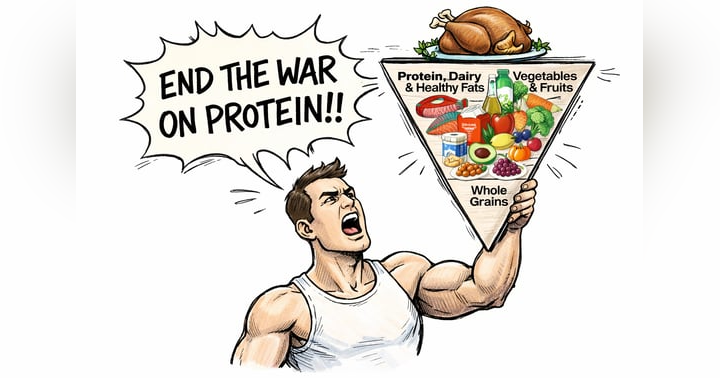
END THE WAR ON PROTEIN!! 💪🏽🏆